Your PPC management strategy affects every lead, every sale, and every dollar you spend on advertising. When your results drop, it’s easy to blame the platform. But the real problems usually come from how the strategy is built, monitored, and adjusted.
Many business owners follow PPC “best practices” they’ve seen online. But PPC checklists rarely hold up in real campaigns, so your strategy has to follow hard data and real buyer actions.
Below, you’ll see the PPC mistakes that hold most campaigns back and the practical fixes that improve performance over the long run.
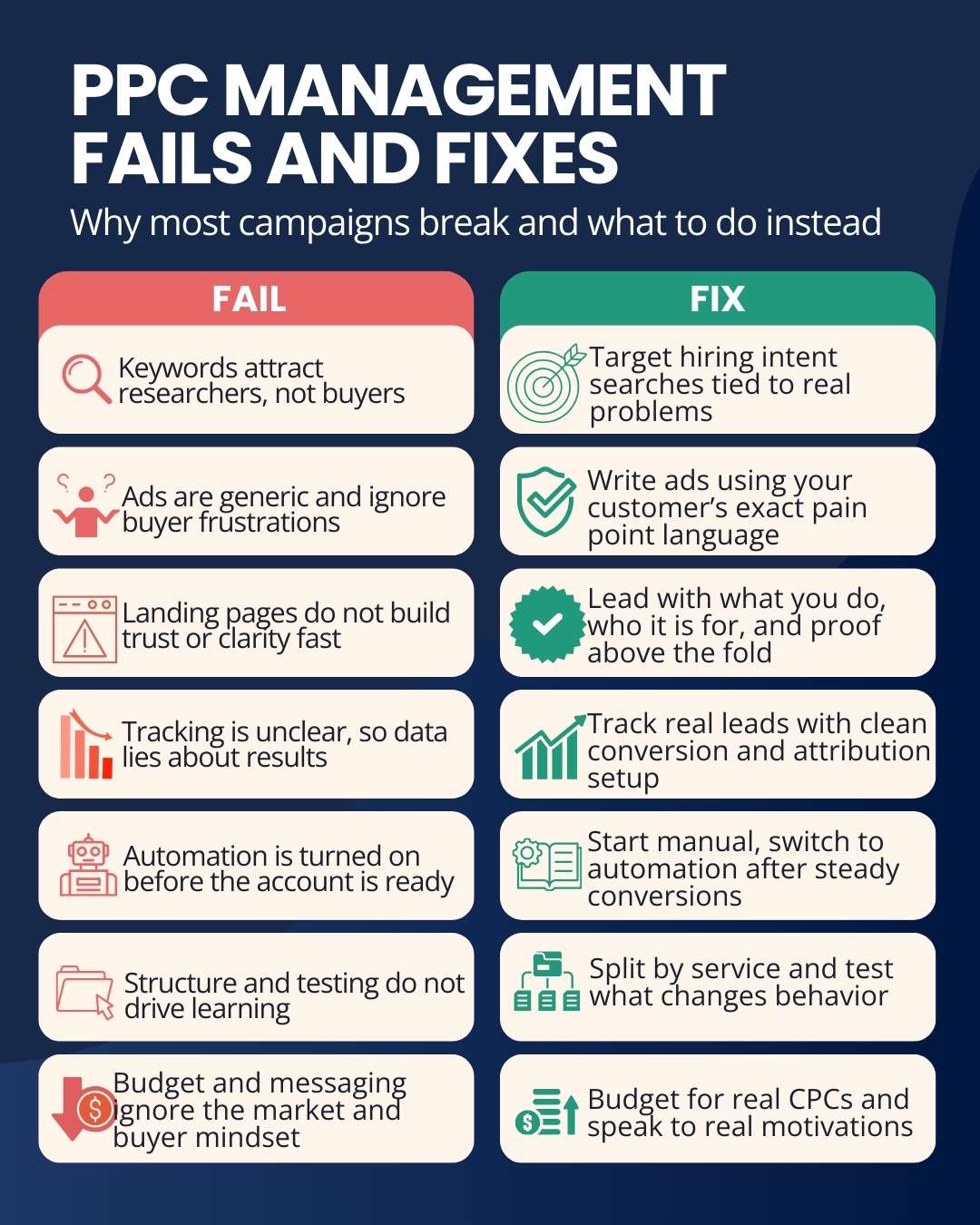
Your Keywords Don’t Match How Real Buyers Search
Many PPC campaigns fail because the keyword list looks strong on paper but doesn’t reflect how real buyers think and search. High-volume keywords often attract people who have zero intention of hiring anyone: students researching definitions, job seekers, or people learning how a concept works.
When your ads show up for these searches, you pay for clicks from people who will never become customers. Your real buyers use more specific searches. They look for someone who can solve a problem, fix an account, or take work off their plate.
Their intent also changes during the week. Someone searching on a Monday may be comparing options, while someone searching on a Thursday may be ready to hire. If your keyword strategy doesn’t reflect this behavior, your budget gets spent on the wrong audience.
How to Fix It
Focus on keywords tied to hiring intent, not general interest. These searches produce fewer clicks but higher-quality leads, giving your budget more room to work.
Your Ads Don’t Speak to the Problem Your Buyer Wants Solved
Most ads fail because they talk about the service, but not the problem the buyer wants fixed. Small business owners click on ads when they see a clear solution to what’s frustrating them.
Generic headlines like “Professional PPC Management” or “Certified Google Ads Specialists” sound fine, but they don’t reflect what the buyer is actually thinking.
Buyers want relief from overspending, poor results, and confusing metrics. They want to know whether you can help them lower costs, improve lead quality, or straighten out a messy account. When your ads speak directly to these concerns, the message becomes far more compelling.
How to Fix It
Write ads using the language your buyer uses. When you address their specific frustrations, you create a message that earns the click.
Your Landing Page Doesn’t Build Trust Quickly Enough
A landing page needs to earn trust almost immediately. Visitors decide within a few seconds whether your business feels credible. Many pages lose leads because they focus on design elements or long explanations instead of delivering quick clarity.
A strong landing page tells visitors what you do, who you help, and why they should believe you before they scroll. It should present clear proof, such as reviews and real results, and make it easy for someone to take the next step.
When a visitor has to search for answers or question whether your business is legitimate, they leave.
How to Fix It
Put clarity and trust at the top of your landing page. Lead with what you do, who it’s for, and a quick trust signal to reassure the visitor they’re in the right place.
Your Tracking Isn’t Giving You Reliable Data
A large number of PPC problems come from tracking that isn’t set up correctly. When the system counts the wrong actions, such as page views or general website activity, you end up with misleading data. That makes it impossible to tell which parts of your campaign are working and which are wasting money.
Accurate tracking is what guides good decisions. Without it, you may invest more in keywords or ads that don’t actually bring in customers. Clean tracking ensures that Google focuses on actions that matter and learns from real leads, not empty clicks.
How to Fix It
When your data is clear, your strategy becomes easier to optimize and more cost-effective. Your tracking should include:
✓ real form submissions
✓ call tracking
✓ button click activity
✓ keyword-level attribution
✓ device-level attribution
✓ time-of-day performance insights
You’re Using Google’s Automation Too Soon
Google often recommends automated bidding strategies, but these tools only work when your account already has steady conversions and clean data. Small business owners sometimes switch to automation because it seems easier, but doing so too early can cause costs to rise quickly.
Automation works best when the platform understands who your ideal customer is. Without enough information, Google makes assumptions that can lead to higher CPCs and inconsistent results.
Managing bids manually at the start helps you understand how your account behaves before handing decisions to an algorithm.
How to Fix It
Begin with manual bidding to learn how your account performs. Once you have consistent lead volume, automation becomes a safer and more effective option.
Your Campaign Structure Doesn’t Match Your Services
Your campaign structure should reflect the way your business operates. When too many services or keywords are grouped together, the data becomes cluttered and hard to interpret. This is a common issue for small businesses trying PPC for the first time, and it leads to confusion about what’s working.
A clean structure helps you understand which services drive results and which keywords support them. It also improves ad relevance, reduces wasted spend, and makes optimization far more straightforward.
How to Fix It
Use a simple yet effective structure that gives you clarity and control, helping you avoid unnecessary spending and improve your insights over time. It should include:
✓ one campaign per service
✓ one intent per ad group
✓ one theme per keyword set
You Aren’t Testing the Elements That Lead to Real Learning
Testing is an important part of improving PPC performance, but many small business owners test the wrong things. Changing minor visual elements doesn’t help you understand your buyer’s behavior.
You want tests that show you why someone clicks, fills out a form, or chooses your business over a competitor. Meaningful tests explore differences in intent, messaging, layout, and offers. These types of tests reveal how your audience thinks and what motivates them.
When you learn something useful about your buyer, you can build a strategy that stays effective long-term.
How to Fix It
Test elements that influence behavior, not aesthetics. Focus on changes that reveal what your audience values and responds to.
Your Budget Doesn’t Match the Reality of Your Market
Your budget affects how often your ads show, how fast you gather data, and how strong your results become. In competitive industries, clicks can cost more. If your daily budget is too low, you won’t generate enough activity for Google to understand your audience or optimize your ads effectively.
Even a well-structured campaign can struggle if it doesn’t get enough impressions or clicks. A realistic budget keeps you present in the auction, supports ongoing optimization, and gives your strategy room to grow. Underfunded campaigns often look “broken,” when the real issue is insufficient spend, not bad marketing.
How to Fix It
Set a budget that aligns with your industry’s cost-per-click. This helps your campaign generate steady data and consistent results.
Your Competitors Understand Buyer Psychology Better
PPC success isn’t just about keywords. It’s about understanding how buyers make decisions. Competing businesses that speak directly to the buyer’s worries, priorities, and hesitation will outperform advertisers who rely on generic messages.
Strong PPC strategies reflect a deep understanding of what motivates your customers. That includes their pain points, what they value in a service provider, what builds trust, and what removes friction.
When your ads and landing pages reflect these insights, buyers feel understood and more willing to take the next step with your business.
How to Fix It
Use messaging that speaks to real customer motivations. Show that you understand their challenges and can solve them better than competitors who rely on generic copy.
Why Partner With Little Big Marketing for PPC Management
Little Big Marketing helps small business owners get more from every advertising dollar by focusing on strategy, clarity, and data, not guesswork. While many agencies rely on generic keyword lists or automated, hands-off management, we take a more intentional approach built around how your customers actually search and what motivates them to take action.
When you work with us, you get:
- Campaigns aligned with real buyer behavior.
- Clear reporting that shows exactly what drives results.
- Data-driven adjustments that lower costs and improve lead quality.
- Continuous optimization instead of “set it and forget it.”
- A strategy managed with the same care as our own budget.
If you want PPC management that prioritizes measurable results—not empty clicks—Little Big Marketing gives you the structure and support your business needs to grow.
Final Thoughts
Your PPC strategy fails for understandable reasons: unclear targeting, the wrong keywords, weak landing pages, or tracking that doesn’t tell the truth about your results. The good news is that each issue is fixable with a more focused, data-driven approach. With clean structure, smart testing, and the right budget, you set yourself up for stronger results.