Search is changing.
Instead of scrolling through pages of search results, people are increasingly turning to AI-powered platforms like ChatGPT, Google AI Overviews, Perplexity, and Microsoft Copilot to get immediate answers. These tools summarize information from multiple sources and deliver direct responses to users in seconds.
For businesses and marketers, this shift creates a new challenge. If AI tools are providing the answers, how can your website become one of the sources they rely on?
The answer lies in answer engine optimization (AEO). By adapting your content strategy to meet the needs of AI-powered search, you can improve your visibility, build authority, and stay competitive as search behavior evolves.
The Rise of AI-Powered Search
Traditional search engines have focused on delivering lists of relevant web pages. AI-powered search takes a different approach. Users ask questions in natural language, and AI systems provide direct answers based on information gathered from trusted sources.
This change is already influencing how people find information online. Instead of searching for “best project management software,” a user might ask, “What is the best project management software for a small business with remote employees?”
As AI adoption grows, businesses must adapt their content to align with these conversational search habits.
The impact could be significant. According to Gartner, traditional search engine volume is expected to decline by 25% by 2026 as users increasingly rely on AI chatbots and virtual agents for answers. This prediction highlights why businesses should begin preparing for an AI-driven search landscape today.
What Is Answer Engine Optimization?
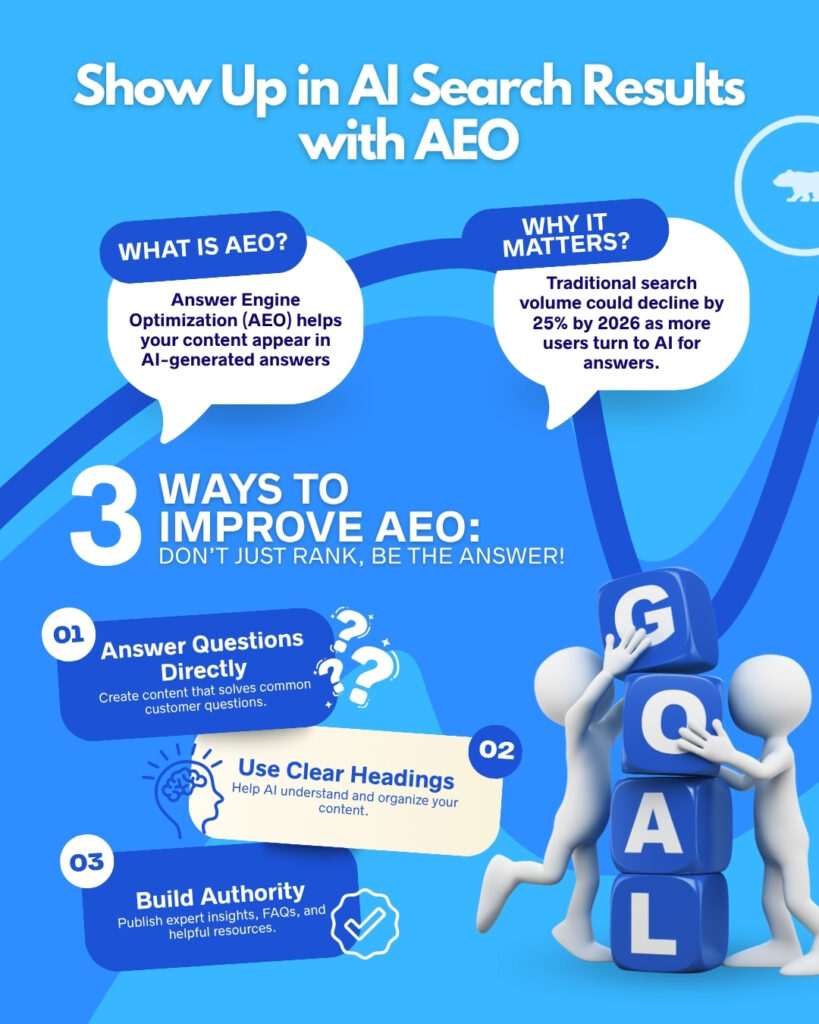
Answer engine optimization (AEO) is the process of creating and structuring content so AI systems can easily understand, extract, and present it as part of their responses.
While traditional SEO focuses on improving rankings in search engine results pages, AEO focuses on increasing the likelihood that your content will be referenced or cited in AI-generated answers.
The two strategies work together but serve different purposes.
SEO aims to drive clicks to your website. AEO aims to make your content the answer users see when interacting with AI tools.
For businesses, this means creating content that is accurate, easy to understand, and organized in a way that helps AI systems identify relevant information quickly.
How AI Search Engines Choose Content
AI platforms prioritize content that demonstrates relevance, trustworthiness, and expertise. When evaluating sources, AI systems often consider factors such as:
- Content accuracy
- Topical relevance
- Website authority
- Information freshness
- Content structure and clarity
Websites that consistently publish helpful, reliable content are more likely to be viewed as trustworthy sources.
Building authority also matters. Strong author profiles, industry expertise, quality backlinks, and well-researched content can help establish credibility with both search engines and AI systems.
Creating Content That Answers Questions Directly
One of the most effective AEO strategies is focusing on user questions. People interact with AI tools by asking questions, which means your content should be designed to provide clear answers.
Consider creating content around:
- Frequently asked questions
- How-to guides
- Definitions
- Product comparisons
- Step-by-step tutorials
For example, instead of only targeting a keyword like “AEO strategy,” create content that answers questions such as “How does answer engine optimization work?” or “What are the benefits of AEO for small businesses?”
Providing direct answers near the beginning of a section can also improve your chances of being referenced by AI-generated responses.
Structuring Content for AI Readability
Content organization plays a major role in AEO. AI systems need to understand the context and hierarchy of information on a page. Clear formatting helps them accomplish this.
Use descriptive headings and subheadings to organize your content logically. Each section should focus on a specific topic and provide a concise answer before expanding into additional details.
Short paragraphs, bullet points, and clear language improve readability for both users and AI systems.
The easier your content is to scan and understand, the more likely it is to be identified as a useful source.
Strengthening Your Website’s Authority Signals
Authority is becoming increasingly important in AI search. Businesses can strengthen their authority by publishing content around related topics and building comprehensive resource libraries. This approach demonstrates expertise within a specific subject area.
Additional ways to build authority include:
- Adding detailed author biographies
- Publishing original research
- Sharing customer success stories
- Creating case studies
- Regularly updating content
These elements help establish trust and signal that your content is backed by real-world experience.
Technical Elements That Support AEO
Technical optimization remains important.
Structured data, often called schema markup, helps search engines understand the content and purpose of your pages. FAQ schema, article schema, and organization schema can provide valuable context.
Website performance also matters. Fast-loading pages, mobile-friendly design, HTTPS security, and clean navigation contribute to a better user experience and support overall search visibility.
Technical improvements may not guarantee AI citations, but they create a stronger foundation for both SEO and AEO efforts.
Measuring the Success of Your AEO Strategy
Tracking AEO performance requires a broader perspective than traditional SEO metrics alone.
Useful indicators include:
- AI-generated referral traffic
- Brand mentions in AI platforms
- Featured snippet appearances
- Organic visibility trends
- Lead quality and conversions
You may also notice increases in branded searches and customer inquiries as your content gains visibility across AI-powered search experiences.
Monitoring these signals can help you understand whether your content is becoming a trusted source.
Conclusion
AI-powered search is changing how people find information online. As more users rely on AI-generated answers, businesses need to adapt their content strategies to stay visible.
Answer engine optimization (AEO) helps position your content as a trusted source by focusing on clear answers, strong authority signals, and user-focused content.
Want to improve your visibility in AI search results? Little Big Marketing helps businesses develop AEO and SEO strategies that increase online visibility and drive qualified leads. Contact our team today to learn how we can help your business stay ahead of the future of search.