Every business wants more website traffic, qualified leads, and higher sales, but deciding how to achieve those goals isn’t always straightforward. One of the biggest questions business owners face is whether to invest in PPC management or focus on SEO first.
Both strategies can deliver impressive results, but they differ in cost, speed, and long-term impact. Understanding when to use each can help you make smarter marketing decisions and get the most from your budget.
Choosing the Right Digital Marketing Strategy
Every business has different priorities, so every marketing strategy should reflect those priorities. A startup introducing a new service often needs immediate visibility, while an established company may focus on building long-term authority and consistent organic traffic.
Before deciding where to invest, consider a few key questions:
- How quickly do you need new leads?
- What is your monthly marketing budget?
- Are you promoting a new service or expanding an existing one?
- How competitive is your industry?
Your answers provide a strong foundation for choosing the right strategy. In some cases, PPC management delivers the fastest results. In others, SEO offers greater long-term value. Many businesses eventually benefit from using both together.
What Does PPC Stand For?
PPC stands for pay-per-click, a digital advertising model where businesses pay only when someone clicks on their advertisement. Google Ads is the most widely used PPC platform, although paid campaigns are also available on Bing, Facebook, LinkedIn, and other advertising networks.
Effective PPC management goes far beyond launching ads. It involves continuous planning, testing, and optimization to improve campaign performance over time. A successful strategy typically includes:
- Keyword research
- Audience targeting
- Budget management
- Ad copy optimization
- Landing page improvements
- Performance tracking
The goal isn’t simply to generate more clicks. Instead, effective PPC management focuses on attracting qualified visitors who are more likely to become paying customers.
Understanding SEO and How It Works
Search Engine Optimization (SEO) helps your website appear in unpaid search results when potential customers search for products or services related to your business. Instead of paying for every visitor, you earn visibility by creating content and improving your website’s overall quality.
A well-rounded SEO strategy often includes:
- Publishing valuable content
- Optimizing website structure
- Improving page speed
- Building trustworthy backlinks
- Targeting relevant search terms
Unlike PPC, SEO requires patience. Search engines need time to evaluate your website before rankings improve. Once your pages establish authority, however, they can continue generating qualified traffic for months or even years.
Which One Is Better, SEO or PPC?
There isn’t a one-size-fits-all answer because the better strategy depends on your business goals, budget, and timeline. While PPC management and SEO both help businesses appear in search results, they do so in very different ways.
Speed of Results
One of the biggest differences between SEO and PPC is how quickly they produce results.
PPC management provides immediate visibility. Once your campaign is approved, your ads can begin appearing at the top of search results within hours. This makes PPC ideal for businesses launching new products, promoting limited-time offers, or needing leads right away.
SEO takes longer to produce measurable results because search engines need time to crawl, index, and evaluate your website. Although rankings don’t happen overnight, a well-executed SEO strategy can continue driving qualified traffic long after the initial optimization work is complete.
Cost and Budget
Both strategies require an investment, but the costs are structured differently.
With PPC management, you pay each time someone clicks your advertisement. Your budget remains flexible because you control daily and monthly spending, but traffic typically stops when your ad budget runs out.
SEO doesn’t charge for individual clicks. Instead, the investment goes toward creating quality content, improving technical performance, and optimizing your website over time. While the upfront effort may be significant, successful SEO can generate ongoing traffic without paying for every visitor.
Traffic and Visibility
PPC and SEO also differ in how they generate website traffic.
PPC places your business in sponsored search results, allowing you to reach potential customers immediately for targeted keywords. This visibility is especially valuable in competitive industries where ranking organically may take considerable time.
SEO earns visibility through organic search rankings. As your website builds authority and relevance, it becomes easier to attract visitors naturally, helping establish long-term online credibility.
Long-Term Growth
If your goal is sustainable business growth, long-term performance becomes an important consideration.
SEO creates lasting value by building authority, increasing brand trust, and generating consistent organic traffic over time. Well-optimized content can continue attracting visitors months or even years after publication.
PPC offers flexibility rather than permanence. Businesses can quickly scale campaigns up or down, making it an excellent solution for seasonal promotions, product launches, or changing marketing priorities.
Control and Flexibility
PPC gives businesses complete control over nearly every aspect of a campaign. Budgets, keywords, audiences, ad copy, and scheduling can all be adjusted in real time based on performance.
SEO is less immediate. While you control your website and content, search engine rankings ultimately depend on Google’s algorithms and ongoing optimization efforts. Changes often take weeks or months before their impact becomes noticeable.
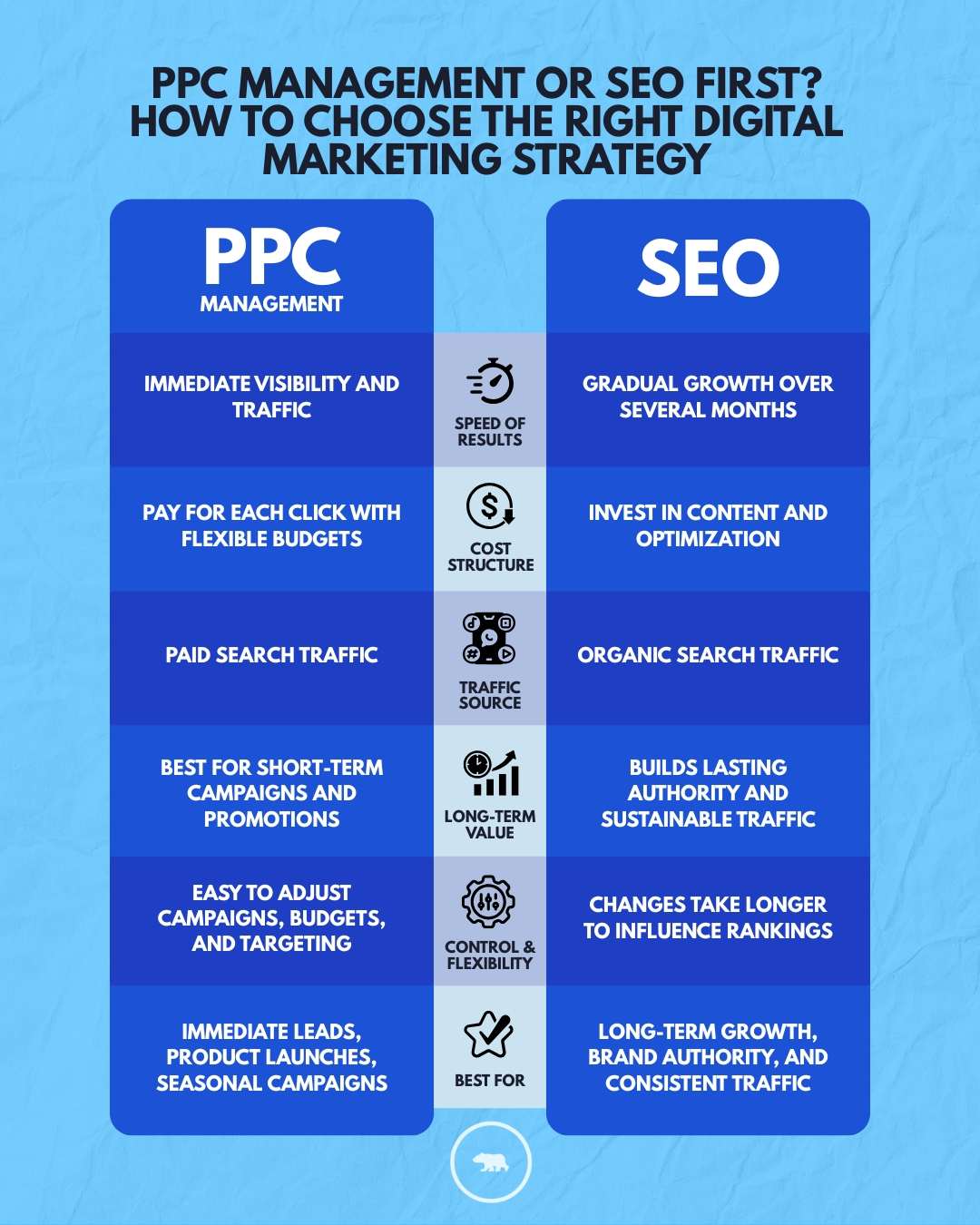
| Factor | PPC Management | SEO |
| Speed of Results | Immediate visibility and traffic | Gradual growth over several months |
| Cost Structure | Pay for each click with flexible budgets | Invest in content and optimization |
| Traffic Source | Paid search traffic | Organic search traffic |
| Long-Term Value | Best for short-term campaigns and promotions | Builds lasting authority and sustainable traffic |
| Control & Flexibility | Easy to adjust campaigns, budgets, and targeting | Changes take longer to influence rankings |
| Best For | Immediate leads, product launches, seasonal campaigns | Long-term growth, brand authority, and consistent traffic |
Best Fit for Your Goals
Choosing between PPC and SEO ultimately depends on what you want to accomplish.
If your priority is generating leads quickly, testing new products, or driving traffic during a promotion, PPC management is often the stronger choice.
If your objective is building long-term authority, increasing organic visibility, and reducing dependence on paid advertising, SEO provides greater value over time. Rather than asking which strategy is better overall, consider which one best supports your current business goals.
For many businesses, the strongest digital marketing strategy combines PPC management for immediate results with SEO for sustained, long-term growth.
When PPC Management Should Come First
Some business situations call for speed, making PPC management the better first investment. Consider PPC if you:
- Need leads immediately
- Are launching a new business
- Have a seasonal promotion
- Operate in a highly competitive market
- Want to test new products or services
Google reports that businesses earn an average of $2 in revenue for every $1 spent on Google Ads, highlighting the potential return of professionally managed campaigns.
Another advantage is flexibility. Campaign performance can be monitored in real time, allowing marketers to adjust budgets, keywords, bidding strategies, and messaging based on measurable results.
When SEO Should Be Your First Priority
SEO often delivers the greatest value for businesses focused on sustainable, long-term growth. You may want to prioritize SEO if your goal is to:
- Build consistent website traffic
- Strengthen brand credibility
- Reduce dependence on paid advertising
- Improve local search visibility
- Publish educational content that attracts future customers
Although results take longer to achieve, SEO continues working long after individual pieces of content are published. Over time, those efforts can generate a steady stream of qualified visitors without paying for every click.
Why Many Businesses Combine PPC Management and SEO
PPC management and SEO work well together because each addresses the other’s limitations. PPC delivers immediate visibility and leads but requires ongoing ad spend to maintain traffic. SEO takes longer to produce results, but once rankings improve, it can generate consistent organic traffic without paying for every click.
When combined, PPC helps fill the gap while SEO gains momentum, and SEO helps reduce long-term dependence on paid advertising. PPC campaign data can also reveal high-performing keywords and audience insights that strengthen SEO content and optimization efforts. Together, they create a more balanced digital marketing strategy that supports both short-term results and sustainable growth.
For businesses looking to integrate both strategies, Little Big Marketing offers comprehensive PPC management and SEO services. Their team develops coordinated campaigns that help businesses generate immediate leads while building a stronger online presence for long-term success.
Building a Strategy That Supports Your Business
Both PPC management and SEO can help your business grow, but they achieve that growth in different ways. PPC offers immediate visibility and measurable performance, while SEO builds long-term authority and sustainable organic traffic.
Rather than asking which strategy is universally better, consider which one best supports your current goals. If you need quick results, PPC may be the right starting point. If your focus is long-term growth, SEO deserves serious consideration.
For many businesses, the strongest approach combines both. Using PPC to generate immediate leads while SEO builds lasting visibility creates a balanced digital marketing strategy that continues delivering value over time.