
Your website is often one of the first places potential customers go to learn about your business. But as your business grows and changes, the website that once worked well may start to feel outdated, confusing, or simply out of step with what customers need.
A thoughtful redesign can help fix those gaps by improving navigation, content, functionality, and the overall user experience. The goal is to make it easier for visitors to understand your business and know what to do next.
So, how does a San Diego website design agency approach a redesign? Here’s what the process can look like from the initial website audit to planning, design, development, testing, and launch.
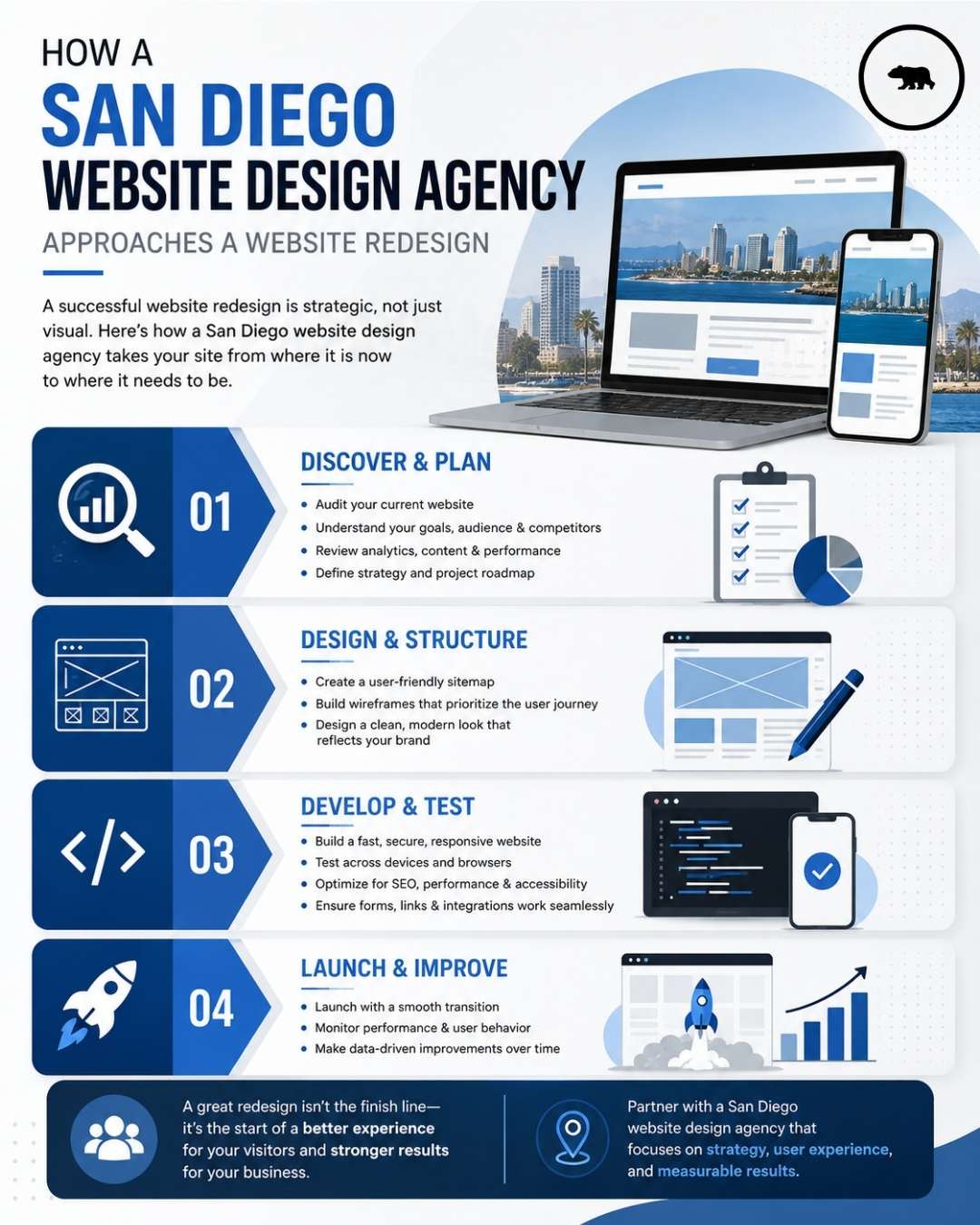
Step 1: Audit the Existing Website
Before deciding what the new website should look like, it helps to understand the old one.
A website audit can reveal problems involving page speed, mobile responsiveness, broken links, navigation, search visibility, content, and conversions. Analytics may also show which pages attract visitors, where people leave, and which content continues to perform well.
The goal isn’t necessarily to replace everything. A strong service page, useful resource, or effective conversion path may be worth preserving. An audit helps separate what should stay from what needs to change.
Step 2: Define What the Redesign Needs to Accomplish
“Make the website look more modern” is a starting point, but it isn’t a complete redesign strategy.
A business might need its redesigned website to generate more leads, explain complex services more clearly, improve mobile usability, support SEO, or make it easier for customers to request an estimate.
Setting these objectives early gives the project direction. Instead of choosing design elements simply because they look appealing, the team can ask whether each decision supports a specific business or user goal.
Step 3: Understand the People Using the Website
Businesses know their services, but visitors don’t always use the same terminology or navigate information in the way a company expects.
A San Diego website design agency can consider who the primary visitors are, why they arrive, what questions they have, and what they need to accomplish.
For example, a potential customer might follow a journey like this:
Google search → service page → customer reviews → contact page → inquiry
Understanding that path helps determine where important information and calls to action belong. It shifts the redesign from “What do we want to show?” toward “What does the visitor need next?”
Step 4: Rework the Sitemap and Navigation
Once the goals and users are understood, attention can turn to the site’s structure.
Over time, websites often accumulate pages, menu items, old promotions, and overlapping content. The result can be navigation that makes sense internally but feels confusing to visitors.
During a redesign, related information can be grouped together, outdated pages consolidated or removed, and important services made easier to reach. The sitemap can also identify opportunities for new pages that answer common customer questions or target relevant searches.
Good navigation should require as little guesswork as possible.
Step 5: Build Wireframes Before Finalizing the Design
Before selecting colors and imagery, designers may create wireframes. Think of these as simplified blueprints for individual webpages.
Wireframes establish where major elements belong, including headings, service information, images, forms, testimonials, and calls to action. They also help teams evaluate the hierarchy of information before investing time in detailed visual design.
This stage provides an opportunity to ask practical questions: Is the most important message prominent enough? Is the CTA easy to find? Does the page tell a logical story?
Fixing those issues early can be easier than restructuring a finished page later.
Step 6: Create a Visual Design That Supports the Brand
With the structure established, the visual identity begins to take shape.
Typography, colors, imagery, spacing, buttons, and other elements can create a consistent experience while reinforcing the company’s brand. But visual design isn’t only about aesthetics.
A Stanford study examining how consumers evaluated website credibility found that 46.1% of credibility-related comments involved a site’s visual design, including layout, typography, font size, and color schemes.
That doesn’t mean appearances are everything. It does demonstrate why visual presentation deserves careful consideration alongside usability, content, and performance.
Step 7: Design With Mobile Users in Mind
A redesign shouldn’t create a great desktop website and then squeeze it onto a smaller screen.
Responsive design considers how layouts adapt across different screen sizes. On mobile devices, that can mean simplified navigation, readable text, appropriately sized buttons, optimized images, and forms that don’t require endless pinching and zooming.
Performance is especially important here. Large images, unnecessary scripts, and complicated page elements can slow down the experience. Design and development therefore need to work together rather than operate as completely separate stages.
Step 8: Develop and Test the Website
Once designs are approved, developers turn them into functional webpages.
Depending on the business, development might include contact forms, a content management system, scheduling tools, e-commerce features, analytics, or CRM integrations.
Testing follows. Links should work, forms should submit correctly, navigation should behave as expected, and layouts should be reviewed across different devices and browsers.
Accessibility considerations, page performance, analytics tracking, and redirects should also be checked before launch. A page looking finished doesn’t necessarily mean it is ready for visitors.
Step 9: Launch Without Losing What Already Works
Launching the redesigned site requires its own plan.
If URLs have changed, appropriate redirects may be needed so visitors and search engines can reach the new destinations. Analytics should be verified, forms tested again, and important pages checked after the site goes live.
Existing search performance also deserves attention. Valuable content shouldn’t disappear simply because the design has changed.
The objective is to improve weaknesses without unnecessarily sacrificing the strengths the previous website had already developed.
Step 10: Measure What Happens After Launch
Launch day isn’t necessarily the end of a redesign.
Once real visitors begin using the site, analytics can provide valuable information about how the new experience performs. Businesses can monitor organic traffic, conversions, form submissions, engagement, page speed, and other metrics connected to their original objectives.
The findings can then inform future improvements. A website is a working business asset, not something that has to remain unchanged until the next major redesign.
How Much Does It Cost to Get a Website Redesign?
There is no universal price for a website redesign because websites vary enormously in size and complexity.
A small informational site that needs refreshed layouts will involve a different scope than a large website requiring custom functionality, dozens of pages, integrations, new copy, and content migration.
Common factors affecting website redesign cost include:
- Number and complexity of pages
- Custom versus template-based design
- Copywriting and content migration
- E-commerce functionality
- Third-party integrations
- SEO requirements
- Custom development
- Photography and creative assets
- Accessibility requirements
- Testing and post-launch support
When comparing proposals, look beyond the total price. Ask what is actually included. Strategy, UX planning, content migration, redirects, SEO considerations, testing, analytics, and post-launch support can significantly change the scope of two seemingly similar quotes.
What Should You Look for in a San Diego Website Design Agency?
Look for a San Diego website design agency that wants to understand your business before deciding how your website should look. A well-rounded process should consider strategy, user experience, mobile design, development, SEO, testing, and measurable goals rather than treating redesign as a purely cosmetic exercise.
Ask potential agencies how they approach discovery, what is included in their scope, how they test websites before launch, and what happens afterward. Clear answers can tell you a great deal about how your project will be managed.
Redesign With a Purpose
A website redesign can change how a business presents itself online, but its value goes beyond a new appearance.
The process starts by understanding the existing website and defining what needs to improve. From there, user journeys, site architecture, wireframes, visual design, responsive development, testing, and careful launch planning work together to create a more useful digital experience.
Working with Little Big Marketing can help bring these moving pieces together around both visitor needs and business objectives.
If your current website no longer reflects your business or makes it difficult for customers to take the next step, consider starting with an evaluation of what is working, what isn’t, and what a strategic redesign could accomplish.